Researchers cut precious metal use in half for green hydrogen production
by Sitaramanjaneya Mouli Thalluri, Siva Sankar Nemala, Katam Srinivas and Yury V. Kolen'ko
International Iberian Nanotechnology Laboratory

BRAGA, Portugal: A new catalyst design could significantly lower the cost of producing green hydrogen by cutting precious metal requirements while boosting durability in water electrolyzers. The study, published in Chemical Engineering Journal, demonstrates a platinum-nickel-ruthenium medium-entropy alloy that achieves industrial-level performance with only half the precious metal loading of commercial benchmarks.
Proton exchange membrane water electrolysis (PEMWE) is one of the most promising technologies for generating green hydrogen using renewable electricity. However, the hydrogen evolution reaction at the cathode relies heavily on platinum-group metals—scarce, expensive materials that account for a major share of electrolyzer costs. Reducing precious metal loading without sacrificing performance or durability has been a longstanding bottleneck for the field.
The team at the International Iberian Nanotechnology Laboratory (INL), led by researchers in the Kolen'ko Research Group, used a continuous-flow synthesis reactor to create ultrasmall Pt₅Ni₃Ru₂ alloy nanoparticles just 1.5 nanometers in diameter, uniformly anchored on defect-rich graphene.
The key innovation lies in the catalyst's dynamic surface activation. "The as-synthesized material is a pre-catalyst with surface-confined nickel-oxide species," said Sitaramanjaneya Mouli Thalluri, corresponding author of the study. "Under cathodic polarization, these oxides reduce away, exposing a fully metallic alloy surface. The catalyst doesn't degrade, it activates. This is counterintuitive and exactly what you want for long-term operation." Synchrotron X-ray absorption spectroscopy confirmed that the surface restructuring is electrochemically driven.
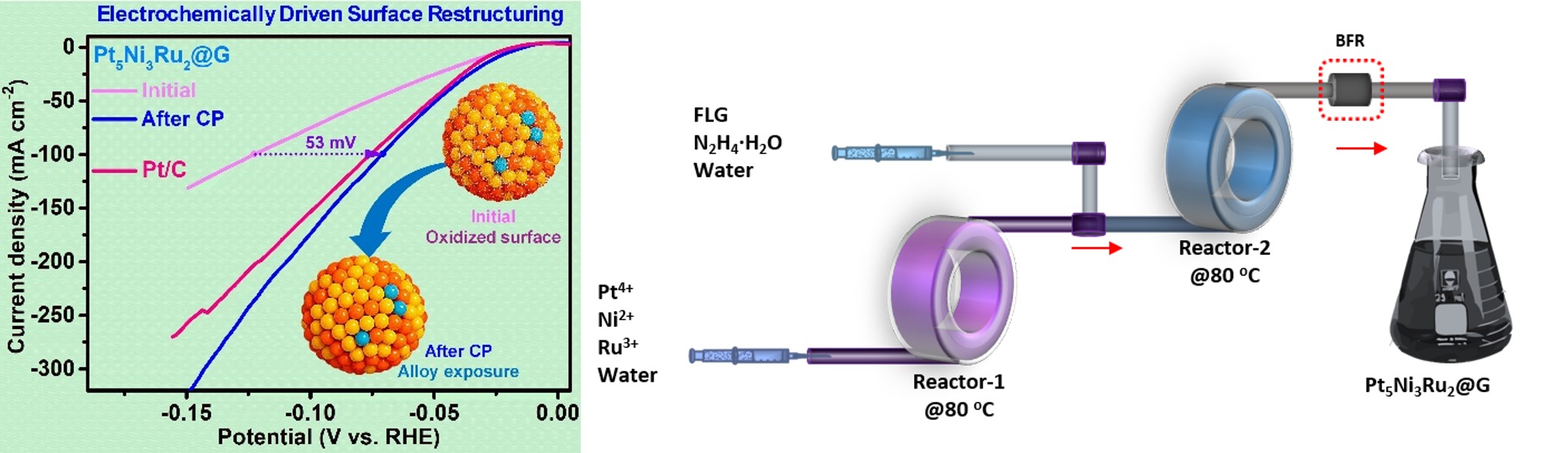
The catalyst contains only 20.5% precious metals by weight, roughly half the loading of commercial 40% Pt/C benchmarks, yet outperforms them across multiple metrics. When integrated into a single-cell PEMWE device, the catalyst delivered a current density of 1.0 A/cm² at just 1.6 V. At 60 °C, typical for industrial operation, the cell maintained stable voltage for over 300 hours, while the commercial benchmark showed continuous performance decay.
"Continuous-flow synthesis is the game-changer here," said Srinivas Katam, co-corresponding author. "It synchronizes nucleation of metals with vastly different reduction potentials, something batch chemistry simply cannot do. This opens a scalable pathway from lab to industry."
"This work demonstrates that medium-entropy alloys, when produced via continuous-flow synthesis, can overcome the traditional activity-stability trade-off," said Dr. Yury V. Kolen'ko, leader of the Kolen'ko Research Group at INL. "The platform we have established extends well beyond hydrogen evolution, opening avenues for designing robust, low-loading multimetallic catalysts across a range of electrochemical energy conversion technologies."
The findings align directly with the EU Green Deal and REPowerEU strategy, which targets 10 million tonnes of renewable hydrogen annually by 2030. By halving precious metal requirements while improving durability, the technology addresses two of the biggest economic barriers to gigawatt-scale PEMWE deployment.
The research was funded by Portugal's Resilience and Recovery Plan under the Next Generation EU framework, through the Innovation Pact "Moving2Neutrality."
More information: Siva Sankar Nemala et al, Dynamic Surface Activation of PtNiRu Medium-Entropy Alloy Catalysts for Durable PEM Water Electrolysis, Chemical Engineering Journal (2026). DOI: 10.1016/j.cej.2026.180266